|
 |
|
|
|
|
|
"Landscopes" -
interactive photography |
|
 |
|
|
 |
|
|
|
 |
|
|
|
 |
|
|
|
 |
|
|
|
 |
|
|
|
 |
|
|
|
 |
|
|
|
 |
|
|
|
 |
|
|
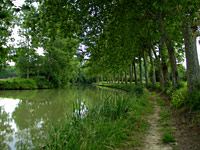
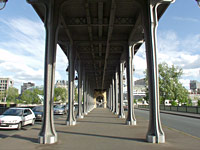
"over
the river and into the trees"
Paris, Bir-Hakeim Bridge |
|
Indeed, measured in terms of quantity of pixels, the brag and bench mark for measuring the capacity of digital cameras, professional models are approaching the finesse of film. In terms of printing, the high definition available, together with the development of high quality printers, is making darkrooms obsolete. Adieu to the bane of printing, getting rid of the very last speck of dust on the negative! Over and above this, the entire process from picture to print being computer based gives the photographer ease and autonomy in her work.
Yet… if the purpose of digital photography is to simply replicate what has been done before on film, then we divest ourselves of a world of creative, conceptual, intellectual possibilities offered by the computer.
At the most basic level, the transfer of the darkroom onto the computer opens up a wide array of possibilities. Image processing techniques have been greatly extended in their technological and artistic possibilities by the use of Photoshop and similar applications. What used to be done with difficulty and sleight of hand in the darkroom, via the direct manipulation of light, where each error meant starting over, can now be done with ease. One shudders to think of the media manipulation tricks that the KGB darkroom goblins would have been able to pull if they had had Photoshop at their disposition.
Nonetheless, the veritable revolution of the computer lies elsewhere, in the vast terrain of possibilities offered by code. Programming allows a picture to develop its own discourse. Malleable pixels let their poetry be expressed via an interactive relationship established with the observer. New horizons are opened up to visual perception. Instead of being a passive spectator "over the photographer's shoulder", the computer allows one to play an active, dynamic role within the matter and meaning of the picture itself.
Interactive photographs are not only sensitive to light, they are also sensitive to the beholder's scrutiny.
Interactive photographs also question the status of the picture itself. As far back as humanity has been a creative, cultural creature, she has decorated the walls surrounding her. This was true in Lascaux, and in the Sistine Chapel. Today, everyone, or almost everyone, hang pictures on their walls. Interactive pictures challenge the inert nature of the traditional recorded scene, whether a painting or a photograph. Even film is inert in the sense that individual frames are strung together in a fixed order. Thus, allowing the viewer to engage in interactive dialogue with a work, that goes beyond passive critique or interpretation, signifies a fundamental break in relation to the traditional meanings of pictorial display.
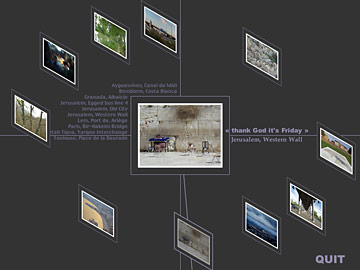
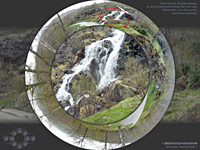
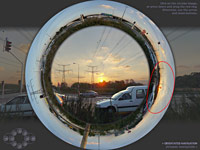
Landscopes is a work which explores both natural and human environments. Interactive photography allows the observer to delve into the fragmentary instants of photographic views. Time and space are deconstructed, and reassembled in accordance with the probing of the observer. Each unique instant is melded into a continuum of simultaneity. The meaning of the picture is transformed by unexpected juxtapositions and permutations which destabilise the photographic reproduction of reality. The Absolute fraternizes with the Arbitrary, the initial, objective photographic recording becomes a zone into which the irrational artifices of the human spirit might infiltrate.
Ten pictures have been made so far in the Landscape series: a description of each can be viewed via the linked vignettes on the left. The pictures are generally too heavy to be downloaded in a reasonable lapse of time. Low definition versions of two pictures - Ayguesvives and Al Aqsa - can be downloaded from their respective pages.
If this work interests you and you wish to obtain a CD-ROM containing the full series, please contact me at joe@magelis.com.